
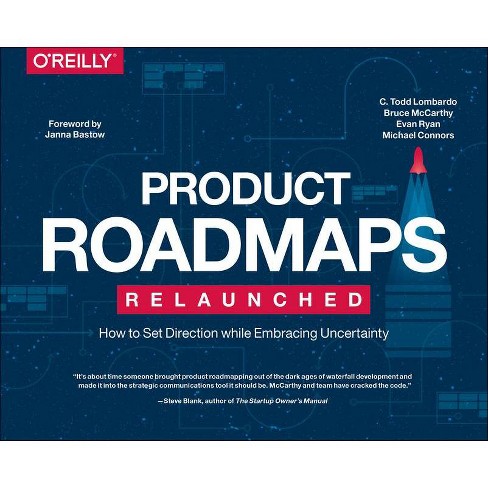
Here you can find attached my learnings from ‘Product Roadmaps Relaunched – How to set direction while embracing uncertainty’.
What is the book about
Written by:
A good product roadmap is one of the most important documents of the organization, as it helps align stakeholders around product goals, giving a visual representation of a strategy. ‘Product Roadmaps’ comes to provide a detailed summary considering all aspects to be considered when designing one.
This is a book mainly addressed to product managers, but also useful for other roles who need to take care of the roadmap in order to communicate and manage expectations.
wHAT i LIKED ABOUT THE BOOK
- It consistently works on the mindset behind product roadmaps. Stating clearly that a roadmap is not a project plan. Plus it goes to the why, talking about the importance of aligning it with the company’s vision and mission. The book explains how the themes and subthemes of our roadmap need to relate to the objectives that will in the end push toward that product vision.
- The holistic approach when defining the contents of the book makes it a very well-rounded book. Plus it makes it easy to collect ideas fast with minimal effort. You can perfectly skip some pages and still get a lot of value out of it. Its combination of tools with ‘light theory’ provides a healthy balance that makes this book compatible with experimented experts and also beginners in the product management world.
- The format is extremely friendly. It clearly aims to cover many user cases so that you can get the answers that you are looking for, and it makes it with images, charts, tables, etc. It makes the book very clear and easy to read.
What I disliked about the book
- Although I understand that the product roadmap is quite a broad topic by itself, the way the contents are distributed around the book feels quite random. It would be nice if the authors had found some way to make it a bit more sequential. For instance, chapter 3 ‘gathering inputs’ could have been followed by chapter 8 ‘achieving alignment and buy-in’, and later on chapter 7 ‘prioritizing with science’.
- At some point, I believe this book is not pragmatic enough when not mentioning at all engineering or the actual development teams, who are the ones responsible for making a technical assessment and setting expectations in the first place. I would have appreciated greater clarity on how all parts contribute to the roadmap rather than focusing on the product side only.
Summary and rating
This book handled multiple aspects of the roadmap in a very detailed manner, covering delicate topics and considering the different stages from ideation to the actual roadmap plotting. Clearly written and to the point, it’s a book that almost anyone can benefit from, however, I would have appreciated a better index and a natural involvement from the development side when defining a roadmap. If roadmaps are an interesting topic for you and your everyday life, I totally recommend this book.
Rating 4/5


 Xavier Figueras